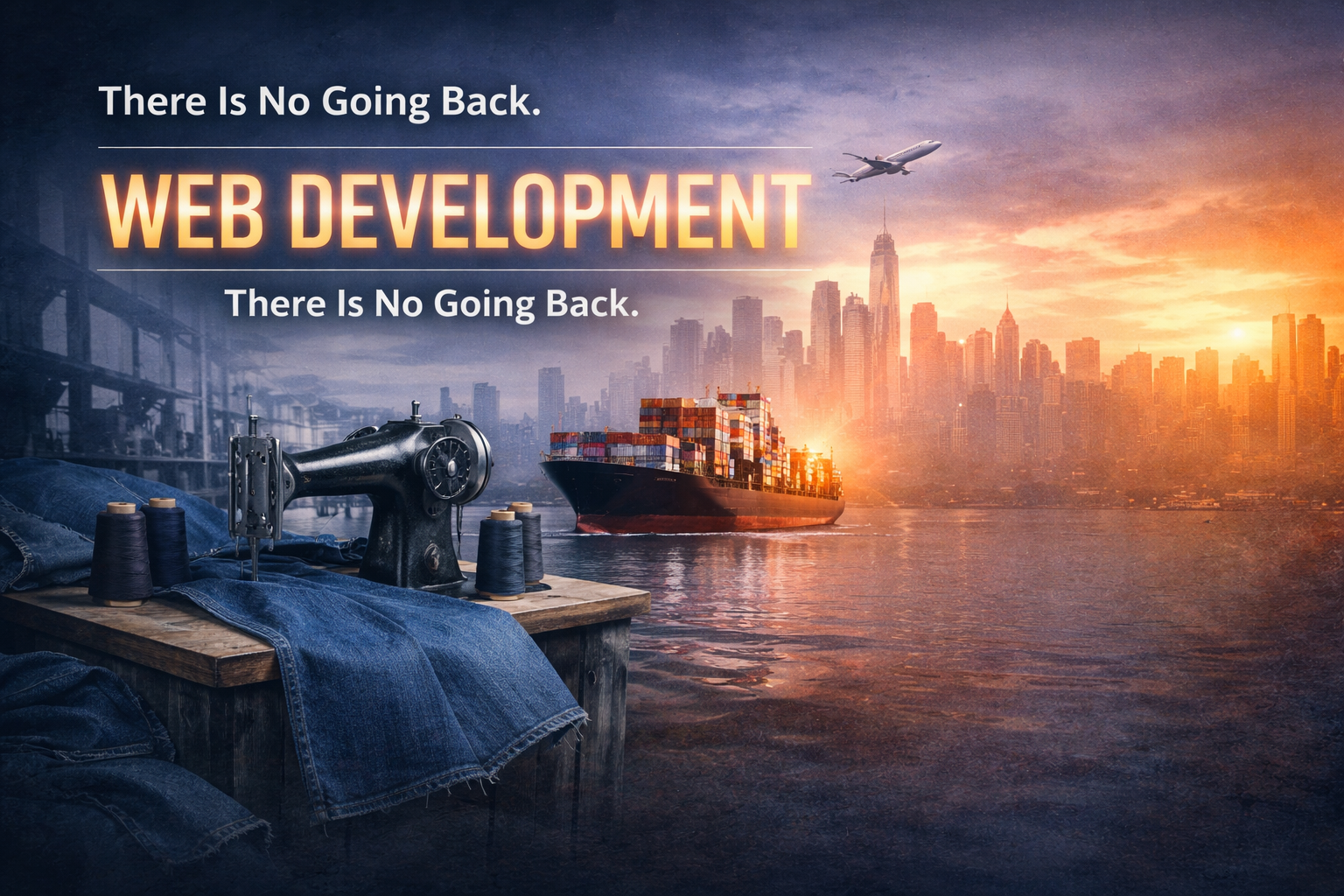
There Is No Going Back.

Umer Farooq
CEO / Founder / Product Guy
Umer Farooq
In this article, Umer Farooq Qureshi, our Chief of Many Things Officer, offers a clear-eyed view of an apparel industry standing at a breaking point. As global dynamics shift, tariffs reshape entire value chains, and technology accelerates change faster than legacy systems can keep up, Umer argues that innovation in fabrics and finishes is no longer enough—what the industry truly needs is a new business model. His perspective challenges suppliers, brands, and creators alike to rethink how they operate, connect, and survive in a world where “there is no going back.”
It’s again that time of the year when the denim industry—brands, fabric mills, garment makers, etc.—comes together to meet and explore what may be “the trend” for the upcoming seasons. You’ll find exhibitors trying to sell the most “innovative” fabrics, very “sustainable” eco washes, and compelling stories…
But the fashion landscape is in overdrive mode. :)
More than innovation in products, stories, and sustainability in materials, what the industry needs is a new business model to operate with.
We are on a journey of deglobalization, and the old world order is wrapping up fast. Tariffs, recession, AI, and the uncertainty of what lies ahead are just too much for everyone to follow, think, and act upon.
The US has already backed out of the Paris Agreement, and tariffs are top of mind for everyone. Whether tariffs are negotiated with each country or not, the landscape won’t be the same in the next six months. Tariffs will effectively wipe out all economic profit for all stakeholders. This enduring nature of tariffs necessitates a fundamental reevaluation of business models within the apparel industry.
This isn’t a bump. It’s new terrain.
Any attempt to keep Chinese players out of competition will only cause more disruption. They may proliferate in other markets. They may flood products into the EU and destabilize that market as well. Let’s not forget—their ability to adapt to change and disruption is far stronger than anyone else’s.
I don’t know whether people will still be interested in listening to product innovation and sustainability stories when their entire existence seems to be at stake.
That’s why shows like Kingpins become even more significant in times like these, where everyone can come together, talk, listen, and share their voice.
Had suppliers worked on establishing D2C channels earlier, they would have been in a much better position today—better equipped to minimize the impact of tariffs and protect their margins compared to traditional distribution channels.
The future (read: survival) belongs to brands and suppliers who adapt digitally, not just creatively, and move beyond the “product innovation as savior” mentality.
I was looking at the posts of many leading mills and apparel makers—and was surprised to see the same product stories, as if nothing had changed.
I would have loved to see someone say,
“We’re coming with a plan to help our customers.”
I hope this season’s show rises beyond the booths, swatches, and familiar conversations to signal a future we all want to live in:
✔️ Where fabric mills evolve into ingredient brands, sharing their stories directly with end customers
✔️ Where real-time feedback, creator commerce, and climate data are part of the storytelling
✔️ Where exhibitors present not just products, but digital capabilities and traceable platforms
✔️ Where startup founders, AI developers, influencers, and emerging designers co-exhibit with legacy mills—and digital marketplaces help them transition into the new channels of distribution
I can see that future very near as the only true “survival kit,” and I want all of you to see it with me. :)
Wishing all the best to @Vivian Wang, the new CEO of Kingpins Show. It’s not an easy time to lead, as there’s simply too much disruption, and very few people have the clarity and courage to pick up the torch and show others the way forward. But I believe you can. 💙
Relevant Blogs